
After the Menasha Tornado: Do You Have a Power Plan or Just a Generator?
Bottom Line Up Front
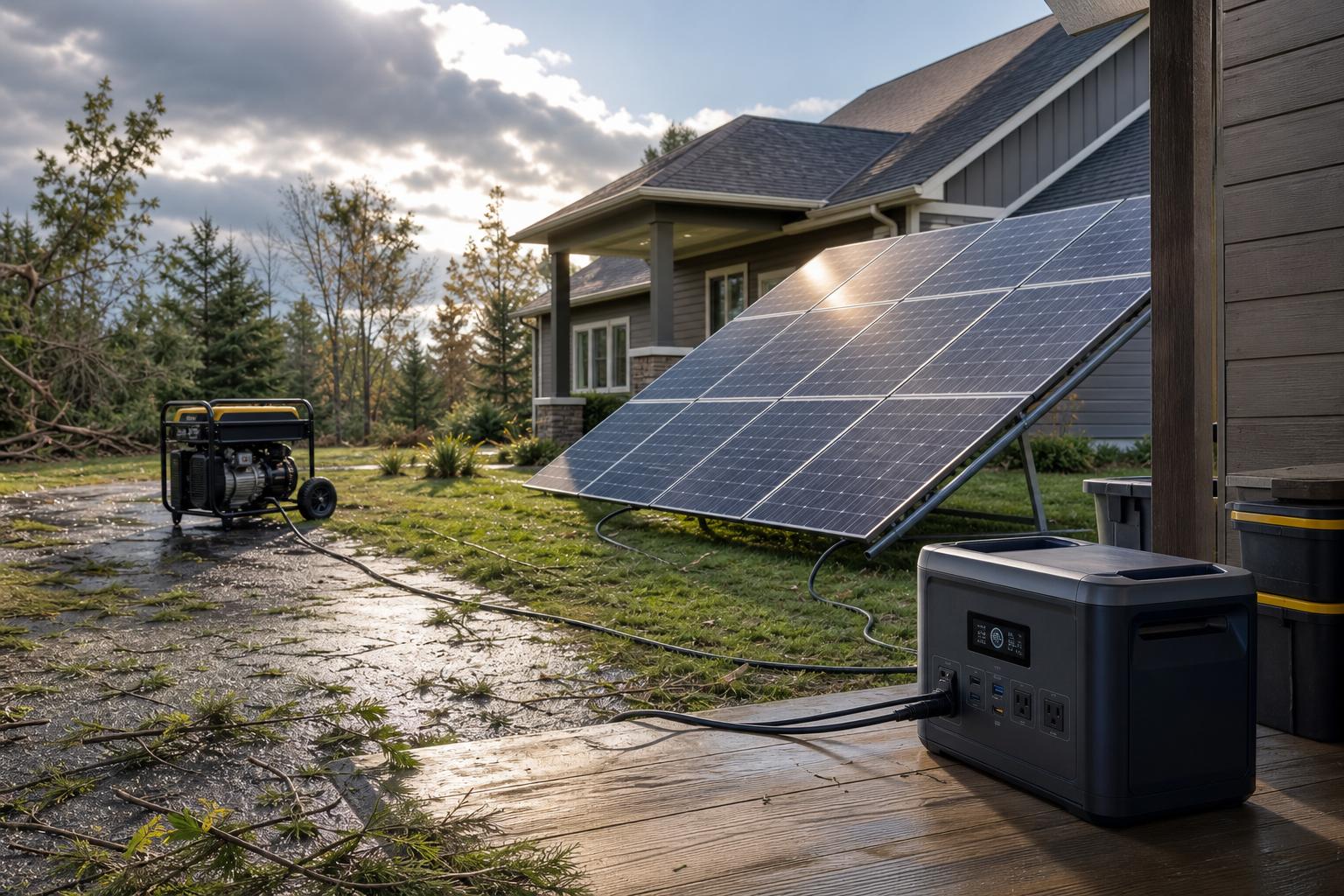
A resilient power plan is rarely based on a single device. The strongest approach combines battery backup for immediate, quiet power; solar panels for renewable recharging; a properly installed fuel-powered generator for large loads or extended outages; and a written plan identifying which equipment actually needs power.
The goal is not to power everything. It is to keep the most important functions operating safely for the duration of the outage.
Why This Matters
The July 27, 2026 tornado that struck the Appleton–Menasha area of Wisconsin damaged homes and businesses, brought down trees and power lines, and initially left more than 30,000 customers without electricity. The National Weather Service classified it as an EF3 tornado, and officials warned that restoring power in some locations could take several days.
The storm illustrates an important preparedness lesson: owning a generator is not the same as having a resilient power plan.
A generator may be out of fuel, damaged, improperly connected, or unsafe to operate near a damaged building. A battery may run out before utility power returns. Solar panels may not provide usable backup power during an outage unless there is adequate sunlight and the system includes equipment designed for outage operation, commonly including a compatible inverter, controls, and battery storage.
Resilience comes from combining systems and planning for their limitations.
The Three Layers of Backup Power
1. Battery banks and portable power stations
Products commonly marketed as “solar generators” are generally batteries with an inverter, charging controls, and electrical outlets. Examples include portable systems from Anker, EcoFlow, Bluetti, Jackery, and similar manufacturers, as well as permanently installed systems such as the Tesla Powerwall.
Manufacturer and product names are provided only as examples. Better Resilience does not endorse any manufacturer or product mentioned in this article.
Battery systems are useful because they:
- Switch on quickly or, in some installations, automatically
- Operate quietly
- Do not produce carbon monoxide during normal use
- Can safely power electronics when properly sized
- Can be recharged from utility power, solar panels, a vehicle, or sometimes a generator
Their primary limitation is stored energy. Once the battery is depleted, it must be recharged.
2. Solar panels
Solar panels can extend battery runtime by producing energy during daylight. However, conventional grid-connected rooftop solar designed to reduce electricity bills normally shuts down when the utility grid fails. This protects utility workers from electricity being sent back onto damaged lines.
Solar panels must be paired with compatible equipment designed to operate independently from the grid if they are expected to provide power during an outage.
Solar production also depends on weather, season, panel placement, shading, and the amount of usable daylight. Solar should therefore be treated as a source of replenishment—not as a guarantee of unlimited power.
3. Fuel-powered generators
Gasoline, propane, natural-gas, or diesel generators can support larger electrical loads and may operate for extended periods when fuel is available.
Their limitations include:
- Carbon-monoxide and fire hazards
- Fuel storage and resupply
- Noise
- Maintenance requirements
- Starting reliability
- Possible power-quality concerns for sensitive equipment
- The need for a properly installed transfer switch when connected to building wiring
Portable fuel-powered generators must be operated outdoors, generally at least 20 feet from doors, windows, vents, and other building openings, in accordance with manufacturer instructions. They should never be operated inside a home, garage, basement, or other enclosed or partially enclosed space.
Generators should therefore be treated as fuel-dependent backup whose reliability depends on safe operation, maintenance, and a dependable fuel supply.
Installation and Interconnection Note
Permanently installed solar, battery-storage, generator, inverter, and transfer equipment connected to building wiring or the utility grid should be designed and installed by qualified professionals and approved or inspected as required by the applicable utility and local authority.
Start With Critical Loads
Before buying equipment, list what must continue operating.
Household priorities may include:
- Refrigeration
- Medical equipment
- Phones and radios
- Internet equipment
- Essential lighting
- Sump pumps
- Limited heating or cooling
Neighborhood, church, nonprofit, or community priorities may also include:
- A charging and communications area
- Refrigerated medications
- Emergency lighting
- Accessibility equipment
- Radios and public-information equipment
- Limited cooling or warming space
Small-business priorities may include:
- Servers and network storage
- Firewalls, switches, Wi-Fi, and internet equipment
- Security and access-control systems
- Point-of-sale equipment
- Refrigeration
- Telephone systems
- Production or medical equipment
- Payroll, dispatch, or customer-service workstations
Each load should be classified as:
- Uninterruptible: Cannot tolerate even a momentary power loss and ordinarily requires a UPS.
- Essential: Can tolerate a brief interruption but must operate during an extended outage.
- Deferrable: Can remain off until utility service returns.
This classification usually reveals that different equipment requires different forms of backup.
Two Preparedness Pathways
Personal and community preparedness
Households and community groups should concentrate on safety, communications, refrigeration, medical needs, and maintaining a limited area for heating or cooling.
A forthcoming guide in this series explains how to estimate basic energy needs, prioritize loads, plan fuel safely, establish community charging capacity, and avoid common generator and solar mistakes.
Small-business continuity
Businesses require a more technical assessment. A generator or whole-building battery does not necessarily prevent servers from restarting when power flickers. Critical technology typically requires an uninterruptible power supply, or UPS, to bridge the gap until another power source starts or to provide enough time for an orderly shutdown.
Businesses should also determine:
- How long each system must remain online
- Whether on-site servers are truly necessary during an outage
- Whether the internet provider will remain operational
- Whether server-room cooling will be available
- Which systems must shut down automatically
- Who has authority to start, refuel, monitor, and stop backup equipment
- How employees will work if the building cannot be occupied
- Whether insurance, leases, permits, or fire codes affect the proposed system
A forthcoming small-business guide in this series addresses these questions in greater detail.
A Practical Hybrid Model
For many households and small organizations, an effective design follows this sequence:
- A UPS or battery immediately supports critical electronics.
- A larger battery system carries essential loads quietly.
- Solar panels recharge the battery when conditions permit.
- A fuel-powered generator operates larger loads or recharges batteries during an extended outage.
- Nonessential equipment remains off to conserve energy and fuel.
This approach reduces reliance on any single power source. It may also allow a generator to operate intermittently instead of continuously, conserving fuel and reducing noise.
Five Questions to Ask Now
- What must remain powered?
- How many watts does each critical device require while running and starting?
- How many hours or days must it operate?
- How will batteries and generators be replenished?
- Who will operate, test, and maintain the system safely?
Backup power should be tested before severe weather occurs. A written plan should identify connection procedures, fuel limits, shutdown priorities, responsible personnel, and the location of operating instructions.
The Takeaway
The Menasha tornado demonstrates that widespread electrical disruption can occur quickly and affect homes, businesses, communications, transportation, and public services at the same time.
A generator is a tool. A battery is a tool. Solar panels are a tool.
Resilience comes from combining those tools into a safe, tested, and realistic plan.
Sources and Further Reading
- July 27, 2026 Severe Storms and Tornado Summary — National Weather Service Green Bay
- Powerful Tornado Leaves Widespread Damage in Wisconsin — Associated Press
- July 2026 Tornado Information and Recovery Resources — Outagamie County
- Solar and Resilience Basics — U.S. Department of Energy
- How to Stay Safe from a Power Outage — Ready.gov
- Portable Generator Safety — Occupational Safety and Health Administration
This article provides general preparedness information and is not electrical, engineering, fire-code, or legal advice. Permanently installed generators, batteries, solar equipment, and transfer equipment should be evaluated and installed by appropriately qualified professionals in accordance with manufacturer instructions, utility requirements, and applicable codes.
0 Comments